
You can't see RF, but you can absolutely shape it. The antenna is what does the shaping. If you're designing enterprise Wi-Fi and treating antenna choice as an afterthought, here's why it deserves more of your attention.
Start with the basic shapes
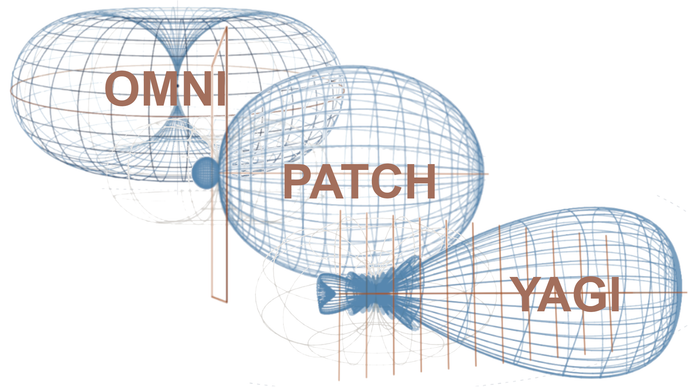
The idealized omnidirectional antenna is drawn as a perfect sphere, but that's not really what happens in practice. A useful way to think about it: imagine cutting an apple. Cut it horizontally (the azimuth view) and you get one shape; cut it vertically from stem to base (the elevation view) and you get a different one. As antenna gain increases, that "sphere" flattens into more of a donut, more signal going out to the sides, less going up and down. A patch antenna stretches that shape further into something like an elongated balloon, and a high-gain Yagi focuses it further still. Think flashlight versus laser pointer.
Omnidirectional antennas, from integrated to rubber ducky
Most modern access points have omnidirectional antennas integrated directly onto the PCB, hidden under the radome. You never see them. Older gear used external dipole "rubber ducky" antennas, and consumer APs went the other direction entirely, sprouting six or eight external antennas that make them look like Wi-Fi spiders. High-gain omnidirectional antennas, used for point-to-point, point-to-multipoint, or outdoor mesh, look more like a broomstick-width radome, often white, sometimes other colors, with gain that can range anywhere from roughly 6 dBi up to 13 dBi depending on the vendor.
Directional, sectorized, and Yagi antennas
Patch antennas are the square ones with a pigtail lead, and they're the right call when you need to shoot RF down a long hallway you can't run cable to, the gain you choose depends on the hallway length and how many clients you expect at the far end. Sectorized antennas focus RF into a defined pathway, typically described in degrees of horizontal and vertical beamwidth (something like 80 degrees horizontal by 30 degrees vertical). Yagi antennas are the most directional of all and are a common way to connect a remote building without trenching conduit or running fiber. Just be sure to check the beamwidth on the data sheet before you commit to the link.
A quick word on antenna math
You don't need to become an RF engineer, but a little dB math goes a long way: a +3 dB gain roughly doubles your coverage area, and +10 dB is roughly a 10x increase (the same logic works in reverse for losses). It matters in practice. Something as simple as a suspended ceiling tile can attenuate signal by 2-4 dB, and losing 3 dB cuts your coverage cell in half.
Mounting matters as much as antenna type
Indoors, hard ceilings (solid drywall) require cutting a hole and installing a locking enclosure. Expensive, and worth comparing against just mounting the AP in a nearby drop ceiling instead. Outdoors, you'll need a protective enclosure, rated for temperature, moisture, wind, and dust, sometimes with built-in heating, cooling, or even solar power options. On rooftops and poles, use metal banding straps instead of zip ties (UV breaks most zip ties down over time), and an articulating arm mount gives you the side-to-side and up-down flexibility to properly aim a patch or directional antenna. In warehouses, expect to mount to I-beams using spring- or chain-suspended hardware designed to flex, not snap if a forklift clips it.
Don't lose the thread on accessories
This is where projects quietly go sideways: lightning arrestors, cable glands, grounding straps, and connector types all have their own thread specs, and if you haven't mapped out the full cable path from AP to antenna in advance, you can end up recommending parts that don't actually mate up. And always specify a drip loop on outdoor cabling. It's a small detail that keeps water from finding its way to your connector.
The bottom line
Antenna choice isn't just a spec sheet decision, it's the thing that determines what your RF actually looks like in the real, physical space you're covering. Get familiar with the shapes, and the rest of the design gets a lot more intuitive.
— Jennifer Huber, CWNE #51