
This project was a passive site survey of a hospital spanning 565,000 square feet across eight floors, conducted over five days to determine whether their current Wi-Fi deployment met the performance thresholds for the clinical applications in use. A passive survey measures existing RF conditions without deploying any test infrastructure. My responsibility was to walk the entire facility, validate and document current Wi-Fi coverage across the 2.4 GHz and 5 GHz bands, and identify any interference sources present in the environment using an AirMagnet Spectrum Analyzer.
The AirMagnet Spectrum Analyzer detected RF energy across the full unlicensed spectrum, including non-Wi-Fi devices that generate interference in the 2.4 GHz and 5 GHz bands. Using the Spectrum Analyzer, I identified over thirty distinct sources of non-Wi-Fi interference that were detectable spectrally but could not be visually located. In those cases, I documented the affected frequencies, noted that the interferers were non-identifiable and would be problematic for most of the 2.4 GHz band, and recorded signal strength and physical location within the building as precisely as the data allowed. Two of the interference sources were affecting up to 90% of the duty cycle available in the 2.4 GHz channels 1 through 9. This means that channels 1 through 9 of the 2.4 GHz spectrum were effectively unusable in that area. I also provided the customer with a verbal walkthrough of each flagged location during the engagement. At the end of five days onsite, I compiled my findings into a seventeen-page deliverable. This survey was done in 2011, and the RF tools available for Wi-Fi engineers have evolved considerably since then, but the documentation methodology and deliverable structure remain representative of how I approach this work.
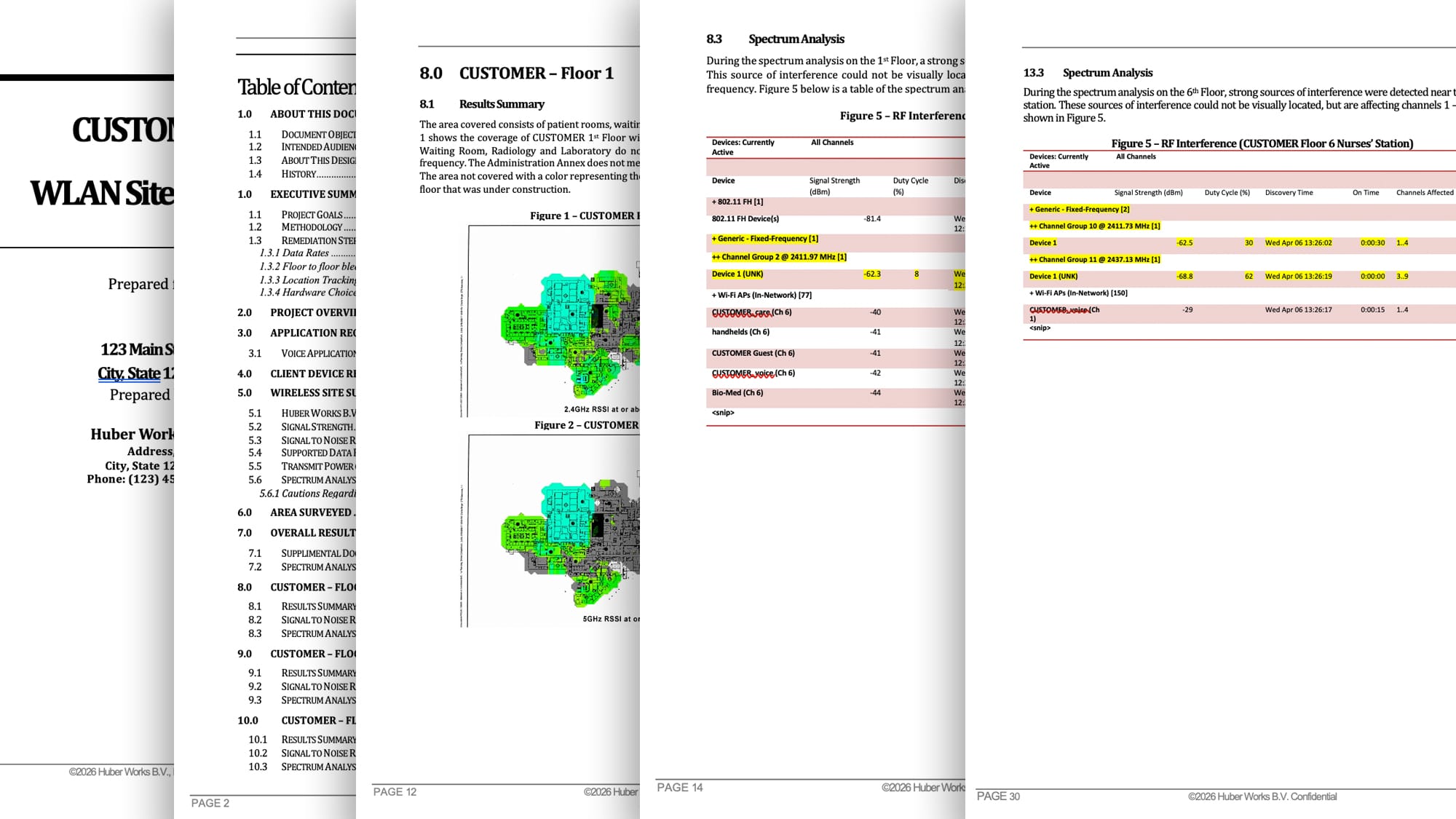
The seventeen-page deliverable compiled all of these findings into a structured format that the customer's team could act on. My documentation included AirMagnet heat map captures for both the 2.4 GHz and 5 GHz bands. Large sections of the hospital did not meet the thresholds of -65 dBm RSSI and 25 dB SNR, and each heat map was annotated to mark the specific locations where coverage fell short.
I provided detailed descriptions of where coverage fell short, documented application requirements and client device requirements for the systems in use, and included RF heat maps for both bands across all eight floors. Application requirements refer to the minimum RF performance thresholds needed for specific clinical systems such as nurse call, telemetry, or voice over Wi-Fi, and client device requirements refer to the wireless specifications of the devices connecting to the network. The deliverable also included the following addendum reports:
• Overall RF Signal Coverage per Channel
• Overall RF Signal Coverage per SSID
• Overall RF Signal Coverage per AP
• Signal Data per Channel
• Signal Data per SSID
• Signal Data per AP
• Channel Interference Report
• AP Interference Report
• Spectrum Analyzer Report
I wore visible identification throughout and introduced myself to the head nurse on each floor before beginning work there. The customer used the deliverable to prioritize remediation in the affected zones. Remediation details and timeline were not shared with me after the engagement concluded.
The full sanitized report is available on request.
If your facility needs a passive site survey with documentation your operations or IT team can act on directly, reach me at Jennifer@HuberWorks.nl to discuss your project.