
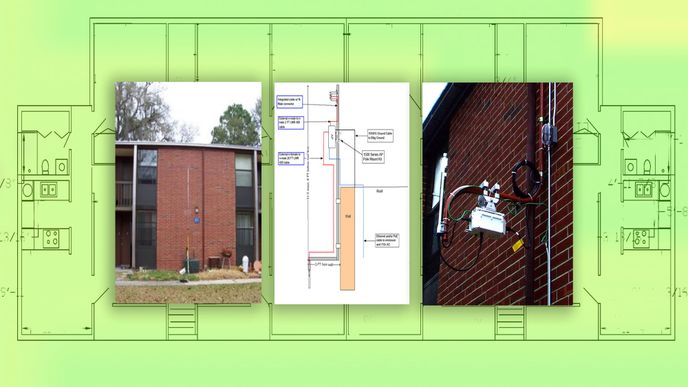
This is a site survey case study for an outdoor mesh Wi-Fi deployment across one square kilometer of student housing. The deliverable it produced was detailed enough that the installation team executed the full design without my presence on site.
Nineteen years ago, surveying for an outdoor mesh Wi-Fi deployment required a switch, a physical Wireless LAN controller and big, power hungry outdoor access points. All of this hardware had significant power requirements and there was no available power source on site. I was surveying student housing for an outdoor mesh Wi-Fi deployment that would replace the students' current self-managed, self-purchased Wi-Fi solutions. The student housing environment had over 98 different access points and SSIDs in use by the residents. This mesh installation would replace this congested Wi-Fi environment with a streamlined design using two rooftop mounted access points and sixteen mast mount access points to provide coverage indoors and outdoors.
The student housing spanned just over one square kilometer and I was scheduled to be there for a week. The site representative for the maintenance team was needed to unlock the students' homes so that I could enter, collect some data points from inside their homes for each mast mounted access point location I was recommending to deploy. There was no room for do-overs for key access. His schedule was just as booked as mine was. I would get my car into place, plug in all the hardware, survey the outdoor area for the given AP location then call the site representative to walk the indoor locations nearest the planned AP location. Repeating this process for sixteen mast mount access points.
The power requirement for the survey hardware required me to use a power inverter and my car battery as the source of power for the equipment stack. I had to go against my natural instincts and drive my car up on the grassy areas, pop the hood, and connect all the gear in the back hatch. I also had to be mindful of how long I had the gear powered on so that I didn't run down my car battery to the point where it wouldn't start. I learned the limit the hard way on the first day. I had to track down someone who could give me a jump so I could make the two-hour drive back home and I didn't want to have to repeat this process for the next several days. For the following survey days I paid more attention to the length of time the survey hardware was powered on and adjusted my working time accordingly. I was building a site survey report one access point at a time.
I created line drawing diagrams to indicate the mounting design for the outdoor access points. The customer could not mount the access points inside the buildings because these were students' apartments. They were built before IDFs for structured cabling in apartments was a concern or a consideration. All of the mounting structure would have to be on the outside of the buildings. I illustrated several potential designs based on the heights and locations I had used for the mesh survey. These designs were recreated as drawn by the customer's facilities team. They used metal conduit, bent to create mounting points for the access points and antennas and even powder coated the conduit piping to mimic the color of the red brick apartments.
My site survey deliverable included AP Location data for all eighteen AP locations, mounting diagrams, antenna orientation, photographs of all the surveyed locations, mounting accessories, and a thorough description of each installation location. My final deliverable contained all the data necessary to implement the mesh Wi-Fi design I was creating without requiring my presence during the installation. The sanitized screen capture below shows five pages of the full twenty-six page report.
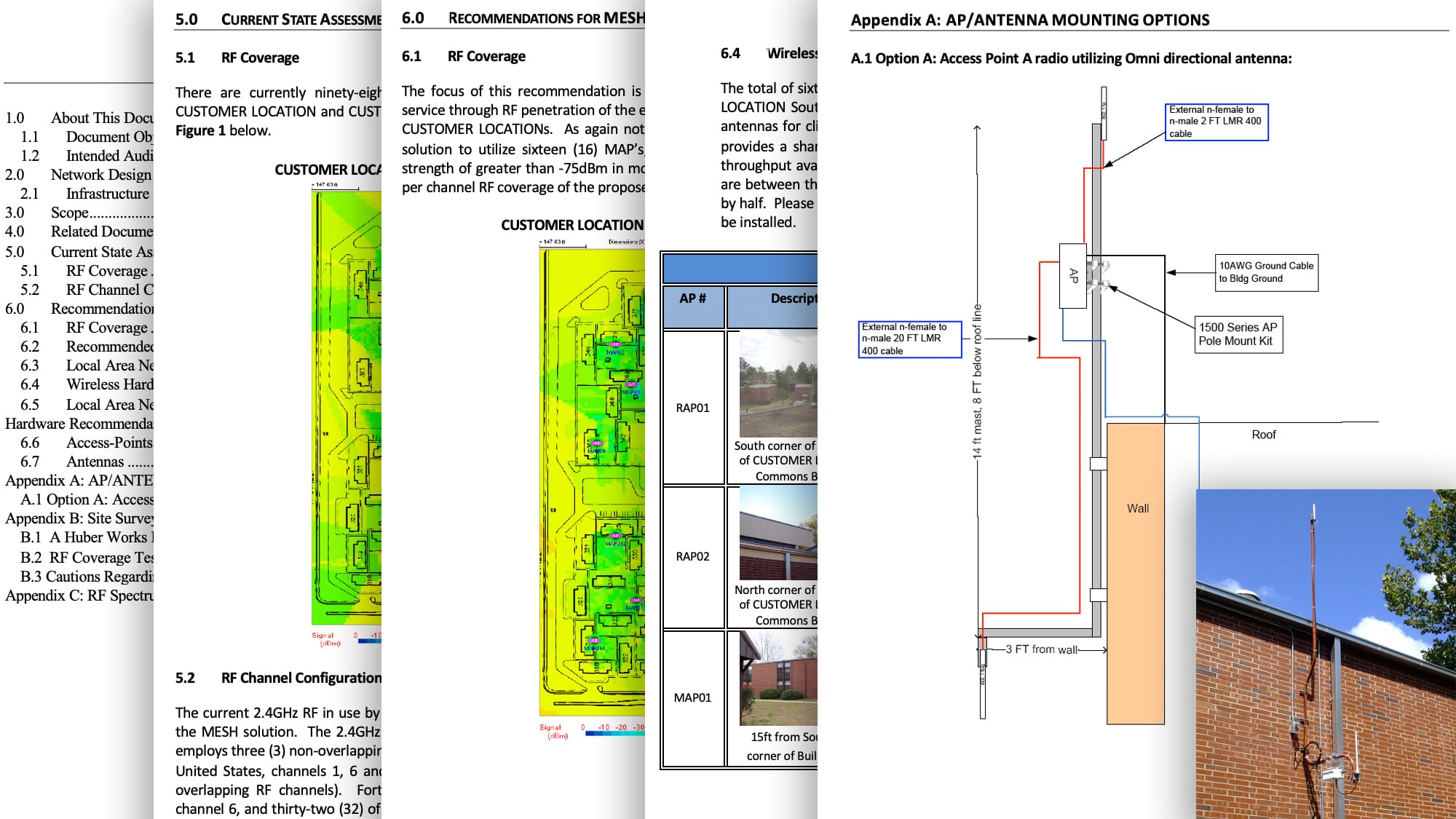
The documentation was detailed enough that the installation team replicated every access point location, antenna orientation, and mounting design without requiring my presence on site. The deployment went live as designed and the residents transitioned from individual consumer internet connections to a managed campus mesh Wi-Fi network.
The full report is available as a sanitized example on request. If your project involves outdoor wireless and you need documentation your installation team can execute without hand-holding, I am available for new engagements. Contact me at Jennifer@HuberWorks.nl