
Seventy-two hospital locations, twenty-nine site survey engineers, and over fourteen thousand access points. The customer had specific documentation requirements for three audiences: the final engineering deliverable, the cabling contractor, and the site-specific installation record. I served as the technical lead for the wireless site survey phase of a twelve-part customer project. My manager assembled the site survey team; training them, and accountability for every deliverable they produced, was mine.
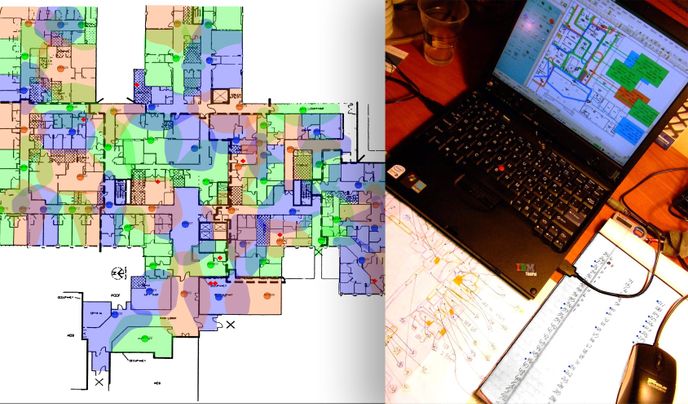
The Visio diagram above is from the sanitized site survey deliverable for one of the seventy-two locations. This image also shows my survey laptop and my hand-drawn diagram of each access point coverage as surveyed. The Visio was the customer-facing deliverable, not a working sketch. The colored shapes represent channel and frequency assignments; the notation marks interference sources, IDFs, MDFs, and microwave oven locations.
Conforming to the customer's documentation and methodology guidelines required rigorous, specific training materials. I wrote the documentation guidelines handbook that the team would use throughout this project from the ground up, based on the customer's requirements. I led three in-person training sessions of ten engineers each, over three days per session. I told them at the outset that this training would differ from how they had learned to do wireless site surveys. Site surveys are traditionally done with site survey software which records the RF measurements in the software and generates digital RF heat maps showing coverage. The customer's preferred methodology for survey and documentation was non-negotiable; no rationale was provided. Every deliverable they produced came through me for review before customer handoff. An inaccurate deliverable meant either a return visit to the site to re-survey the affected area, or an error propagating into hardware procurement.
The site survey data determined access point placement, hardware quantities, and channel assignments for the installation phase. Getting that data required advance coordination at seventy-two hospital locations: security badge access, mobile survey carts at each site, and scheduling around patient care areas with restricted hours. With logistics in place, the survey methodology itself was where the customer's requirements diverged from standard practice.
This project used the tools standard for enterprise wireless surveys at the time of the engagement (2007-2008), applied in a way the customer specified rather than in their default mode. The customer required the use of AirMagnet Laptop Wireless LAN Analyzer v7.0 to document each actively surveyed access point's coverage cell. The coverage threshold was -65 dBm RSSI and 25 SNR for 2.4 GHz, and -70 dBm RSSI and 30 SNR for 5 GHz. The customer specified that channels 36, 40, 44, 48, 52, 56, 60, and 64 were to be used near exterior walls, with channels 149, 153, and 161 reserved for interior spaces not adjacent to external walls or windows. Access point power was to be set to minimize three-dimensional floor-to-floor bleed-through while maintaining adequate coverage of the floor being surveyed. The customer's recommended starting point for 802.11a was 14 dBm (WLC Power 3 or 25 mW). Cell overlap was required to be 20% in roaming areas.
Survey engineers were to use Cognio Spectrum Expert Analyzer to note sources of interference in the site survey report and in the Visio drawing. Microwaves were to be identified by name in both the report and the Visio, not simply logged as interference sources. The RF heat map requested by the customer was a Visio diagram with colored shapes indicating the channel and frequency assignment of each surveyed access point's coverage cell.
The wireless engineers were instructed to mark the drop ceiling grid at each access point location with a colored sticker bearing the full AP name. They were given digital versions of the facility floor plans and instructed to print them on 11x17 paper before arriving at each site. Survey engineers were provided with colored pencils and instructed to mark up the 11x17 printed floor plans to represent different 802.11b/g channel assignments and to draw the -65 dBm perimeter of the surveyed access points. The paper markup was the field record; the Visio diagram was produced from it and submitted as the formal deliverable. Concurrent with marking up the paper floor plan, they were required to fill in the device information spreadsheet with the access point name and a description of the installation location.
Every document in the package had to be accurate before it was accepted; that accuracy was what drove reliable hardware procurement, installation, and configuration. The final deliverable was not a single document; it was a structured package with distinct sections covering RF coverage, interference data, hardware counts, naming conventions, and installation-ready Visio drawings.
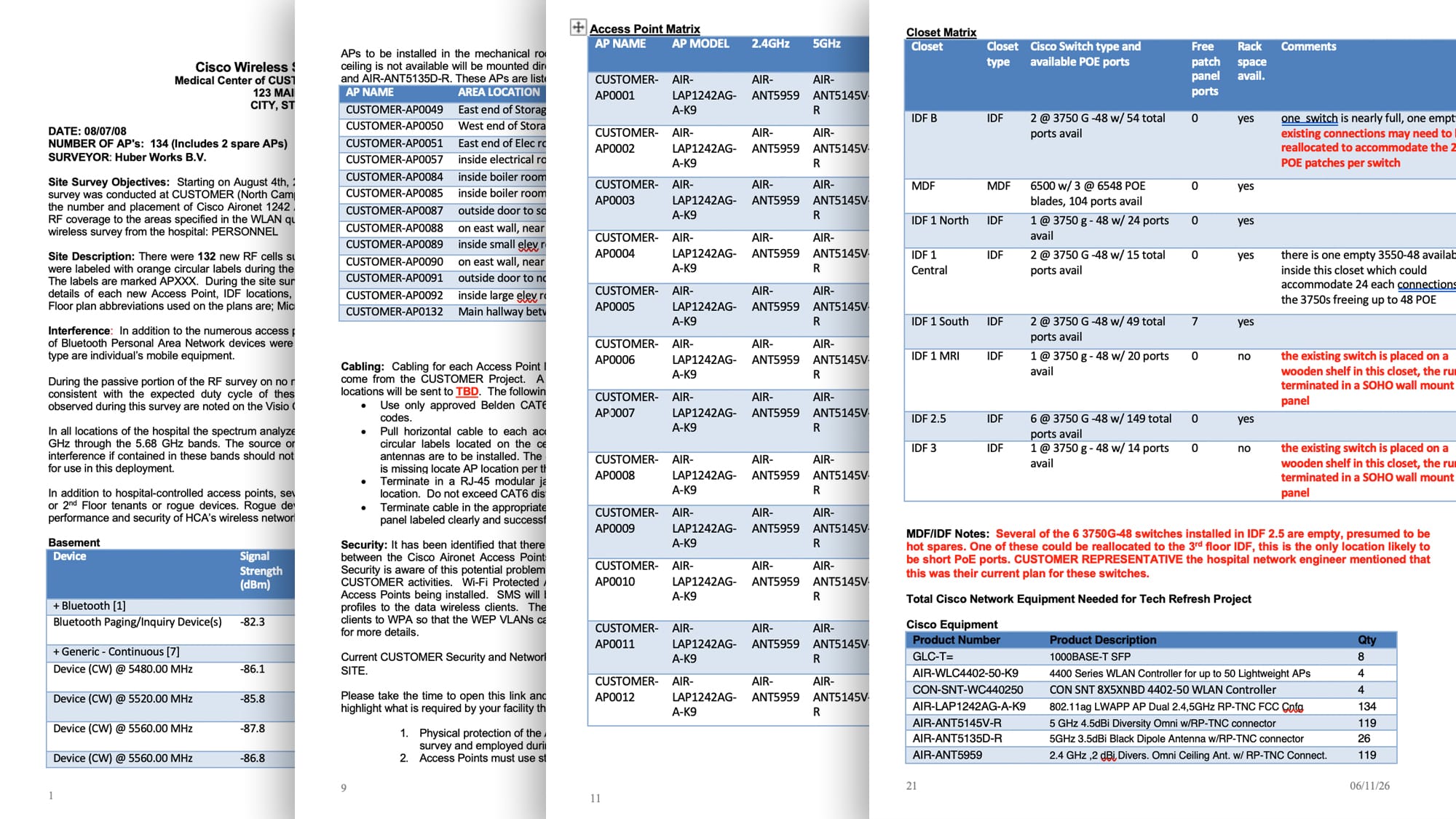
Wireless Survey Requirements
Documentation Guidelines
Visio Documentation Guidelines
Creating the 802.11B/G Visio Page
Creating the 802.11A Visio Page
802.11A Channel Distribution Changes
Device Info Spreadsheet
Final Deliverable Word Document
Total AP/Cable Drop Count & Antenna Counts
Omnidirectional Ceiling Mount Antennas
Dipole Omnidirectional Antennas
Wireless LAN Controller Counts
Interference (Spectrum Analysis) Documentation
WLAN Quote
Naming Conventions
Each section had its own documentation standard and came through me for review before the package was assembled. Fewer than five reports across seventy-two locations required a second submission. The errors that triggered revision were consistent in type: incorrect AP naming, missing notations, channel assignments in the Visio that did not match the spreadsheet. If I did not catch the error, the customer would catch it and send it back to me for review.
The survey, installation, and configuration across all seventy-two locations spanned a full calendar year. The customer's final acceptance of the site survey documentation drove hardware procurement and installation across all seventy-two locations.
The full sanitized site survey report from this project is available on request. If your project requires a Wi-Fi survey lead who can train a distributed team, build and enforce a documentation standard, and review deliverables before they reach your customer, reach me at Jennifer@HuberWorks.nl